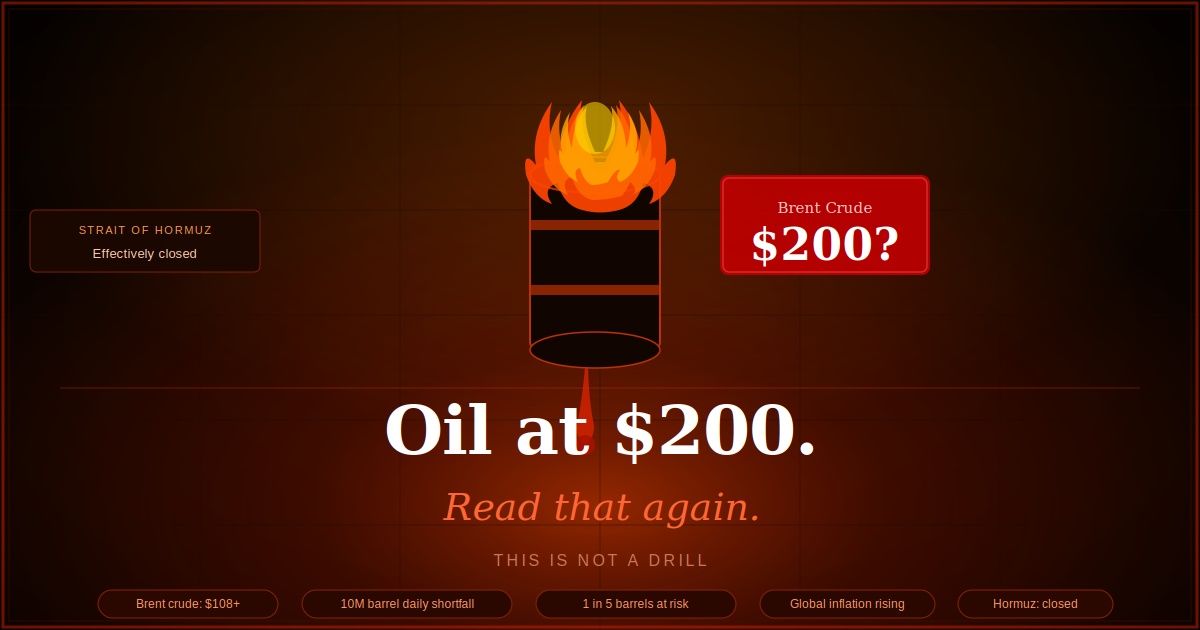
One narrow waterway. One-fifth of the world’s oil. And nobody has a plan.
There is a passage of water between Oman and Iran that, at its narrowest point, is just 33 kilometres wide. You could drive that distance in under half an hour. On a clear day, you might almost see across it.
That passage — the Strait of Hormuz — is now effectively closed. And the world is only beginning to grasp what that means.
How We Got Here
On February 28, the United States and Israel launched strikes on Iran. Within days, Iran declared the Strait of Hormuz closed to shipping. The threat was credible enough that traffic all but stopped. Countries scrambled to negotiate individual safe passage deals. The US attempted to build an international naval coalition to reopen the waterway — and failed to attract meaningful support.
By March 9, Brent crude — the global oil benchmark — had crossed $120 a barrel. It has not fallen below $100 since March 13. On March 18, an Israeli strike on Iran’s South Pars gasfield triggered Iranian retaliatory attacks on energy infrastructure in Qatar, Saudi Arabia and the UAE, pushing prices above $108.
And analysts are not done revising upward.
Wood Mackenzie has said $150 is approaching and that $200 is not “outside the realms of possibility.” Oxford energy expert Adi Imsirovic calls $200 “perfectly possible.” Iran’s own military spokesperson told the world to “get ready” for it.
Why This Is Not Just an Energy Story
Here is where most coverage loses the thread.
Commentators frame this as a Middle East conflict story, or an energy markets story, or a geopolitical story. It is all of those things. But at its core, it is something far more intimate: it is a story about what people pay for food, how businesses survive, and whether economies that were already strained can absorb another shock.
The International Monetary Fund has a precise estimate for this. Every 10% sustained rise in oil prices adds 0.4% to global inflation and removes 0.15% from global economic growth. We are not talking about a 10% rise. Oil has roughly doubled from where it was before this conflict began. The arithmetic is not comforting.
Oil does not just power cars. It is embedded in the production of fertiliser, plastics, pharmaceuticals and synthetic materials. It moves goods across oceans and continents. When oil becomes dramatically more expensive, the price of almost everything else follows — not immediately, not all at once, but steadily and without mercy. The people who feel it first and hardest are, as always, those with the least buffer.
Singapore-based OCBC Group Research estimates that even with the emergency release of 400 million barrels from international strategic reserves — a significant coordinated intervention — the global market is still facing a daily shortfall of around 10 million barrels. Reserves can buy time. They cannot replace a closed strait.
The Fragility We Built and Chose Not to See
What unsettles me most about this moment is not the crisis itself. Crises happen. What unsettles me is how little surprise it should occasion.
For decades, roughly one-fifth of the world’s oil supply has flowed through a single narrow waterway in one of the most geopolitically volatile regions on earth. This was not a secret. It was not an oversight. It was a known, documented, repeatedly flagged vulnerability that the global economy chose to accept because the alternative — genuine diversification of supply chains, accelerated transition to alternatives, serious investment in resilience — was expensive, complicated and politically inconvenient.
The highest Brent crude has ever traded was $147.50 per barrel, at the peak of the 2008 global financial crisis. Adjusted for today’s dollars, that equates to approximately $224. We are being told, calmly and by serious people, that we may be heading toward that territory. Bob McNally of Rapidan Energy Group puts it plainly: the trajectory will depend on how fast two forces — buyers chasing scarce oil at any cost, and buyers exiting the market through demand destruction — play out against each other.
Nobody knows which wins. Nobody knows how high prices go before the system finds a new equilibrium. That uncertainty alone is its own kind of damage.
What Comes Next
There are reasons for cautious optimism. Output has increased in the US, Canada, Brazil, Argentina and Guyana. Alternative supply routes exist, including Saudi Arabia’s East-West Pipeline. The historical pattern holds that high prices eventually cure themselves by destroying the demand that drove them up.
But the keyword in that last sentence is “eventually.” In the meantime, inflation rises, growth slows, and the cost lands on ordinary people in the form of higher prices for fuel, food and goods — in countries that had nothing to do with starting this conflict and have no power to end it.
That is perhaps the most important thing to sit with. The consequences of what happens in one narrow strait, between two shores you could almost shout across, will be felt in supermarkets in Dhaka, petrol stations in Nairobi, and heating bills in Manchester.
We built a world this interconnected. We built it this fragile. And now we are living in the moment when that fragility is no longer theoretical.
Sources: Al Jazeera, Wood Mackenzie, IMF, OCBC Group Research, Rapidan Energy Group, University of Oxford, University of Massachusetts Amherst
