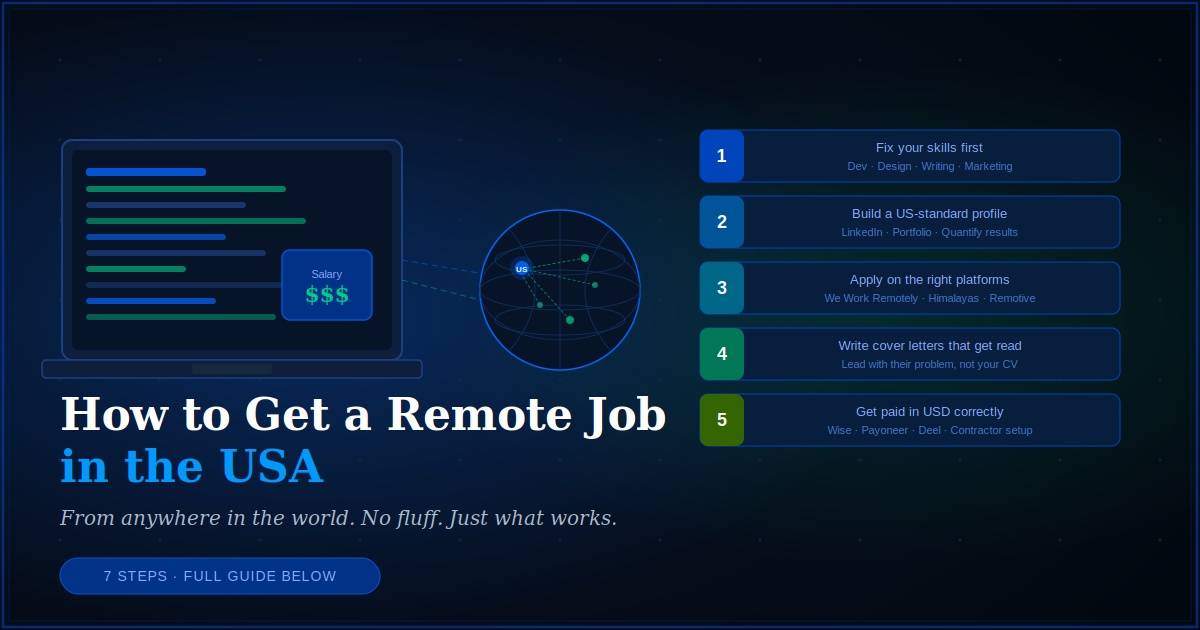
Most people fail at this not because they lack skills. They fail because they are applying the wrong way, to the wrong places, with the wrong profile.
Here is exactly what works.
First, understand what “remote USA job” actually means
There are two types:
- Location-independent remote — the company does not care where you are. You get paid in USD. You work their hours or flexible hours. These are the ones you want.
- US-only remote — they say remote but mean remote within the United States. Do not waste your time on these. Look for the words “open to international applicants” or “worldwide” or “anywhere.”
Step 1 — Fix your skills before you fix your resume
No guide can help you if your skills are not marketable to a US employer. The roles that are genuinely open to international remote workers right now are concentrated in these areas:
- Software development (especially React, Python, Node.js, cloud)
- UI/UX design
- Content writing and copywriting
- Digital marketing and SEO
- Video editing and motion graphics
- Data analysis
- Virtual assistance and operations
- Customer support (if your English is strong)
- Accounting and bookkeeping
If you are not in one of these categories yet, that is your first job — not finding a remote position, but getting into a field that offers them.
Step 2 — Build a profile that looks US-standard
American hiring managers make a decision in about 6 seconds. Your profile needs to pass their mental checklist instantly.
LinkedIn is non-negotiable. Set it up as if you already work at the level you are applying for.
- Profile photo — professional, clean background, good lighting
- Headline — do not write “looking for opportunities.” Write your actual role. Example: “Frontend Developer | React | Node.js | Open to Remote”
- About section — write in first person, confident, specific. What you do, who you help, what results you deliver
- Experience — quantify everything. Not “managed social media” but “grew Instagram following from 4,000 to 22,000 in 8 months”
- Set your location to your actual city but turn on “Open to remote work” in job preferences
Your portfolio matters more than your degree. Build one. GitHub for developers. Behance for designers. A personal website with writing samples for writers. A case study document for marketers. If you have nothing to show, build something — a personal project, a spec piece, a redesign of an existing product.
Step 3 — Know exactly where to apply
Stop spending all your time on LinkedIn and Indeed. Most international remote candidates are competing in the same crowded pool. Go where the competition is thinner.
The best platforms for genuinely international remote work:
- We Work Remotely (weworkremotely.com) — one of the best. Filter by category and look for roles that do not specify US only
- Remote.co — curated remote jobs, many open internationally
- Remotive.com — strong for tech and marketing roles
- Himalayas.app — specifically lists whether each role is open to your country
- Toptal — highly selective but pays exceptionally well. Worth the application process if your skills are strong
- Upwork and Fiverr — not traditional employment but how many international workers build their first USD income and their first portfolio of US clients
- AngelList / Wellfound — startups hire internationally and care more about skills than location
- LinkedIn — still useful but filter aggressively. Use “remote” and add “worldwide” or “international” in the search
Step 4 — Write a cover letter that actually gets read
Most cover letters are ignored because they sound like every other cover letter. Do not open with “I am writing to express my interest in the position.” Nobody cares.
Open with something that proves you understand their problem.
Example: “Your job post mentions you are scaling your content operation from 3 to 10 writers in Q2. I have built and managed a distributed writing team of 8 across four time zones — here is how I did it and why it is directly relevant to what you are trying to do.”
Three paragraphs maximum. What you have done, what you can do for them, and one specific reason you want this company in particular. End with a clear next step — not “I hope to hear from you” but “I would welcome a 20-minute call to walk you through my recent work.”
Step 5 — Handle the money side correctly
This is the part most guides skip.
When you work remotely for a US company from outside the US you are typically hired as an independent contractor, not a full employee. That means:
- You invoice the company, usually monthly
- They pay you via Wise, Payoneer, Deel, or direct bank transfer
- You are responsible for your own taxes in your home country
- You do not get US employment benefits like health insurance or 401k
Set up Wise or Payoneer before you start applying. Having a way to receive USD professionally makes you look ready and serious. Deel is increasingly popular as it handles contracts and payments between US companies and international contractors compliantly.
Rates: Do not undersell yourself to compete with the lowest bidder. US companies expect to pay competitive rates even for international contractors. Research what your role pays in the US market and aim for 60 to 80 percent of that range. You are not a cheap option — you are a talented professional who happens to be based elsewhere.
Step 6 — Nail the remote interview
Remote interviews have their own failure modes that nobody talks about.
- Test your internet, camera and microphone the day before. Not one hour before. The day before.
- Use a clean, neutral background. A plain wall is better than a messy room or a fake virtual background that glitches
- Look at the camera, not the screen. This is the single most common mistake. It reads as avoiding eye contact
- Be ready for asynchronous hiring processes — many remote companies use Loom video responses, written assignments or take-home tasks before they ever get on a call with you
- Time zones matter — know exactly what time the interview is in their zone and yours. Showing up an hour late because of a time zone confusion is an automatic rejection
Step 7 — Be consistent and track everything
Remote job hunting is a numbers game with a quality filter on top. You need both volume and precision.
Set a weekly target — for example, 10 quality applications per week. Not 10 copied-and-pasted applications. Ten researched, tailored, portfolio-linked applications.
Track every application in a simple spreadsheet — company, role, date applied, status, follow-up date. Follow up once after 7 days if you hear nothing. One follow-up, politely. No more.
Most people give up after two or three rejections. The people who get these jobs are the ones who treat rejection as data, adjust, and keep going.
The honest timeline
If your skills are market-ready and you apply consistently and correctly: expect 2 to 4 months before your first offer. This is normal. It is not a sign that it is not working.
If you are still building skills: 6 to 12 months before you are genuinely competitive. Use that time well.
One final thing
The remote job market is real. People from Bangladesh, Nigeria, Pakistan, India, the Philippines, Romania and dozens of other countries are working right now for US companies, earning in dollars, from their homes. It is not a myth and it is not reserved for a lucky few.
It is reserved for people who prepare properly, present themselves professionally, and do not quit.
That can be you. But only if you treat this like a job in itself.
Save this post — you will need it. And if this helped you or someone you know, share it. More people need to see practical information like this instead of the usual vague advice.
Drop a comment below — what is the biggest challenge you are facing in your remote job search right now? I read every reply.
